Election 24. The Children’s Care System

By Dairmuid de Rathboann. All sources appear at the foot of the article.

Most children under ten don’t know why they are in care

“You can tell a great deal about a Society about how it treats children “.

The speaker was Nelson Mandela. 

Let’s look at some facts about looked-after children, as reported by the NSPCC.

  • In England, 0.076% of children are “Looked after”.  This consists of young people under 18 in actual care homes and those in short-term foster homes.
  • 25% of the prison population have been in care
  • 25% of the homeless population have been in care 

I first came across the care system as an 11-year-old boy. My parents were altruistic types. My Dad had been a member of the Communist Party until the Soviet Army crushed the Prague Spring in 1968. He then became a volunteer organiser for the Peace People and re settled refugees from the N. Ireland Civil War. Mum was a nurse.

So a pair of pinko lefties were cat nip for hard pressed Social Workers trying to place a tsunami of kids taken into care in the poorest city in the UK.

Neither knew how to say no. After a time of taking kids short term into our shoe box house in north Hull, they asked us to adopt a child.

So began four years of a steady up tick of terrible events. It wasn’t the kids fault. He came to us aged eight having undergone a series of disastrous failed short term placements. Finally this child was left to live under the care of violent nuns. A priest was convicted in the early 90’s of sexual abuse. There is no evidence of a direct link.

Arson, shoplifting, nicking from the Church collection plate, (£80. Kudos) and increasing violence saw the police regularly visiting us. My parents were not in anyway shape or form suitable people to undertake such a task.

Things came to a brutal denouement in July 1983. An argument escalated and my mum received a blow to the head which caused her to lose an eye. When the ambulance arrived I told them what had happened. The police were called. None of us saw this poor wreck of a child ever again. Mum’s life was destroyed. She took her own life in 1987. This event was pivotal, but not the reason.

I became a teacher in 1990. As a Head of Year I quickly saw the very same problems were not only in evidence at Social Services (this time In London) but immeasurably worse.

Harassed social workers working between bouts of stress-induced sick leave, chronic under-funding, inadequate care facilities. A safe environment for children this was not. 

One Children’s Home we came into contact with was under the day-to-day management of the Roman Catholic Church. This was a precursor to the use of private providers to run such institutions. And when I say institution, that’s exactly what I mean. 

I once asked someone, ‘What’s the worst thing about being in care?’ His reply was stark, but not ‘ being tucked in by someone who loves you.”

The speaker was a petty, but persistent offender who I met in a northern gaol. I was part of the Samaritans organisation who trained offenders to act as Samaritan Listeners. This was part of One Nation Tory Ken Clarke’s ambition to reduce self harm and suicide.

Each prison received generous funding which gave a vital cash injection to Samaritan Branches.

The Labour Government continued to support the scheme. Lib Dem Chief Secretary to the Treasury David Laws recommended funding be pulled in 2010. George Osborne needed no convincing.

We limped on until 2013 but the three prisons that I was involved in supporting no longer have the scheme.

The issues of drug use, impulse control, and other psychological problems care leavers face is like climbing an ice wall with an anvil tied to your leg.

To her credit, Theresa May commissioned the Josh McAllister Report. The former PM is certainly not a person I could agree with on anything. But May is, if nothing else, a serious politician. (Unlike Johnson,Truss, Rich-Rishi etc.) 

The best way to read the McAllister report is to concentrate on the bit where he writes for young people. (Please don’t all rush at once, I don’t want to break the internet.)

The report was serious; it listened to a diverse range of stakeholders, and its importance meant that it was authored through COVID-19 before being delivered in January 2022. It begged for £ 2 billion in immediate funding. Unsurprisingly, the government shelved it. 

For those of you who can’t be bothered to read it, it can be summarised as in the following points:

  • Looked after children are very pissed-off. 
  • A sector beset with high staff turnover and low training, with a heavy use of under qualified agency staff.
  • that care homes are better suited for drug deals than studying 
  • that they don’t feel cared about or safe 

This isn’t an issue you will hear about at the General Election. But there is a report on the shelf, full of findings, for the next government to examine. 

Priority one: Give the government brief to someone who knows what it feels like from a child’s perspective. A looked-after child knows what these guys need.

Priority two: A commission into the whole tragedy must be initiated. If and when cash is needed the Banks, who were happy to take billions from the taxpayer should hand over a chunk of the £40 billion in profits they made last year. 

Finally. We have met and become friends with MP’, nurses, teachers and the bloke who fixed my roof, all who have been in care. Most use the word despite a lot.

Notes.

https://learning.nspcc.org.uk/research-resources/statistics-briefings/looked-after-children

Click to access Independent_review_of_children_s_social_care_-_Final_report.pdf

Further information. All4. Kids in Care.
Election 24. TV Debates. What Can We Learn?

Penny Mordant Looses It

In America the election TV debate starts 18 months before polling day. This is because both major Parties use them to whittle down the number of politicians vying to represent either the Republican or Democratic Party before the primary season.

Since 1960 the candidates selected by each Party go head to head. In 1992 Ross Perot took his place as a strong Third Party candidate next to George Bush and the eventual winner, Democrat Bill Clinton.

It took until 2010 for TV debates to land in the UK.
The strange fact is this. Liberal Democrat Leader Nick Clegg was declared the Debate champion. But on polling day the Liberal Democrat’s lost five seats, and their share of the vote barely changed, up by just one percentage point.

The Debates in 2015 were skewed by Prime Minister David Cameron’s baulking at having head to head conversations. 

2017 definitively moved the dial. Theresa May sent her Home Secretary Amber Rudd to speak for the Tories. She had a stinker. Jeremy Corbyn, 20 points behind at the start of Campaign pulled off a surprise. Rudd was left floundering. Liberal Democrat leader Tim Farron similarly failed, succumbing to nerves. 

The final result saw a swing to Labour of 9.6%. They gained 30 seats. Theresa May’s premiership was forever doomed as 13 seats were lost. Farron’s career as Lib Dem leader was sunk as they lost 21 seats.

Corbyn set out a vision which included abolition of student fees, and taking the transport and other utilities back into Public ownership. He came over as clear, honest and relatable. Crucially he treated the other debaters with respect.

This election, possibly due to the dire state of Rich Rishi’s Government and Labour’s play it safe tactic has led to a sterile debate season.

Labour has the ultimate opportunity to provide a step change as in 1979 and 1997 respectively. Thatcher and Blair both identified the calcification of the country and were prepared to risk all in pursuit of a vision to turn the UK around.

The fascinating part of this campaign; and it is radically different, is that the public place issues ABOVE the qualifications of the Leaders. 

IPOs/mori have been polling general elections since 1987 and this information comes from a 5th June poll. 

Whilst 47% of voters think Labour is ready for government, an astonishing 53 say they don’t know what Sir Kier Starmer stands for. A record for a leader expected to take Office.

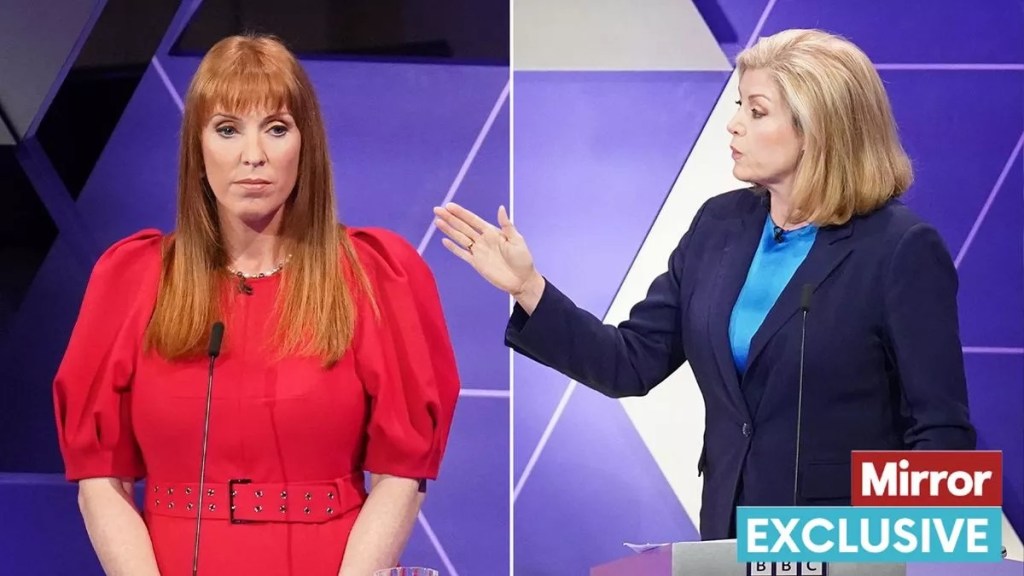
Friday’s debate showed UK politics at its absolute nadir. Tory Penny Mourdant used it as her pitch for post annihilation Conservative leader. Although it was fun to see her stab Rich Richi in the front, it was unsettling to hear a Cabinet Minister tell a lie about tax that had already been squashed.

Mourdant was just attempting to ape Thatcher but without a plan, a vision or 1% of the Iron Lady’s undoubted intellectual ability.

For Labour Angela Raynor blew a golden opportunity to define how the Party would transform the UK. It all felt a bit underwhelming for me. 

Daisy Cooper for the Liberal Democrats was just unmemorable and vanilla. I have no idea what she was trying to outline.

Green Leader Carla Denyer was by far the politician with a vision. Clean energy which would create thousands of well paid jobs. In addition she spoke sense on the need for immigration. The decimation of apprenticeships in favour of University courses of little intrinsic value to the economy has left us with no skilled and highly qualified construction workers 

But like the Scottish Nationalists and Plaid Cymru, the Greens will never be in government.

This election, even more than 1997 is the easiest to predict. 

All the more reason for Labour to be brave, to dare to dream, to provide priceless hope for our young people and most of all to tell a story and deliver a vision of ending the descent into oblivion that the Tory years have put rocket boosters on.

“An English Persons House is Their Castle“

But Not If You’re a Millennial

Time to get real. Time to ask the questions that politicians avoid.

For many born in the glow of the post war consensus, it wasn’t a dream to own your own house. It was a reality.

Even if you didn’t want the hassle of home ownership, public housing was high quality.

The whole house as an investment business came to pass when Thatcherite free market ideology became the orthodoxy in the UK economy.

Thatcher and her weirdo mentor Keith Joseph identified home-owning, shareholding democracy was the foundation on which their Thatcherite dream was going to be built.

The deal sold to many a millennial leaving school after the turn of the century was simple: invest in yourself, study hard, get a graduate job, and you too can be part of the modern British dream. 

After all, when the British electorate was persuaded to smash the post-war consensus and replace it with Thatcherism, they did so on the pretence that the good times would never end.

Whilst there continued to be enough actual homes for purchase, few politicians demurred.

The problems started in the mid 1990’s. Demand rapidly outstripped supply.

For those who bought before 1994. Happy days. Conversations about how much equity people thought they owned became competitive and compulsory around the barbecues of the Thatcherite newly enriched class.

But as we shall see it was a chimera.

Even Anthony Blair didn’t see the need to undo the 1980s neo liberal reforms.

Instead he and Chancellor Gordon Brown decided to implement Labour’s natural altruism through cash-heavy investment in Public Services.

In the first term Education was the main beneficiary. From 2001-10 the NHS underwent a huge transformation due to doubling investment in real terms,

But it wasn’t all bread and roses for the New Labour government.

As a society, Britain made a major irreversible policy step change post the 1979 Conservative Party election victory

The Tories chose to actively use a free market approach to meet our challenges.

Be it energy distribution, communications networks, mass transit, water and sewage, higher education, or housing, everything was up for sale.

45 years on from the glory days (for some) are over. The UK is Broken.

We are now This Septic Isle.

We have an energy crisis, a housing crisis, poo in the rivers, outside of London public transport doesn’t work, and the housing market itself is completely broken. 

Not according to the Tories. To them, all is as should be.

The problem with the Conservatives is that they fundamentally believe that free markets will eventually fix every problem.

Whilst most of us are chafing under the cost-of-living crisis, the Conservatives simply don’t see that there is a problem, and for them to address the problem would require them to admit that they have been wrong for many years.

They would be forced reverse decades of policy positions first adopted under Margaret Thatcher. 

These fundamental problems will not go away.

Just like in 1997, when the Tories broke the country, a Labour government will have to step in and try to steady the ship.

The difference now is that tweaking will not be enough. Starmer can realistically only stop HMS UK from sinking in the first term. But the second term will require vision.

The Tories 1979 style step change must happen in the second term. But on the basis of Social(ist) Democracy where markets are regulated to work for the many.

Housing.

An Englishman’s home is his castle, is it not? But what if the housing market is structured in such a way that many people in full-time work cannot gain access to it? 

Renters are punished by mortgage prices, as are those trying to save for a deposit amidst the cost-of-living crisis.

Yet there are a group of people out there who enjoy wealth generated by the rigged housing market.

Many commercial landlords are people who don’t work as hard and enjoy an excellent quality of life as a result of their canny property market investments. 

Property became a respectable form of gambling. But this belies the fact that it is gambling with regular people’s lives

Landlords add additional pressure to the housing market, to the point where the market is already fundamentally broken.

For years, governments have allowed this to happen.

Property growth can be spun into the falsehood that there is economic growth.

But there are huge moral questions over whether homes should ever be allowed to be commoditised. 

Commoditising energy is one thing, but to commoditise people’s homes risks undermining the entire fabric of society.

Core conservative values preach the importance of the family unit rather than the state to fix our problems.

How is this even possible when many families have zero chance of ever affording their own home.

So, how do you fix the problem?

Build more homes the Tory ministers say. But landlords keep snapping up properties.

Social Housing is probably the only viable solution.

I can’t see the electorate swallowing it.

When most of us think council housing, we think sink estates.

But we have now reached a point where social housing is the only practical answer. 

Only the most extreme left-wingers would reject the liberal premise that property rights are fundamental to a free, open, and democratic society.Once you reject property rights, you move from being a socialist to a communist. 

But the only other alternative to social housing, is to nationalise large property portfolios retained by landlords.

That is unpalatable for many people.

But what about Millennials who may never get on the property ladder, who are reaching their 40thbirthday still living with their parents and with multiple generations under one roof.

They will start to question the property rights of landlords, and whether they are valued above access to the housing market for those who work hard and pay that way.

Ultimately, the right to a decent home is just as important as the right to own property, and in my opinion the right to live in your own space, and make it a hone trumps that of the right to invest in property portfolios.

Ultimately, if we don’t invest in social housing now, then the investment commoditisation of the housing market will have to end. There will need to be a drastic state intervention. 

Now that really is food for thought for Tories everywhere. 

Election 24: “We Need To Talk About Policy“

CIVIC BISCUIT: Politics But Sideways

By Danny Marten and Dermot Rathbone

Policy must decide this election

Ya boo sucks! We don’t want your policy wonkery here! After all, engaging in politics through ‘memes’ and 3-word slogans is much easier than participating in intellectual debate. 

Most of the electorate become bored with politics very quickly.

You only have to look at dire turnout in local elections, with the plebiscite handbook offering excuses such as ‘they’re all the same’, ‘they don’t do nowt” and “they’re all the same. Nothing will change”

This lack of inquiry will lets the politicians off the hook.

Scrutiny begets truth.

That’s why Boris Johnson’s administration was doomed from the start.

By December 2019, the UK had undergone four national votes in five years. The last thing we wanted from Santa was a Christmas election. We were sick of it.

At the same time, Corbyn’s Labour Party had become reductive. There was no credible position on Brexit, and the brilliant 2017 manifesto was discarded.

Instead the Labour Party put in place an ‘anything you like‘ approach to policy, including such gems as free universal broadband.

Conversely the Tories had simple, electorate-friendly slogans; they had an ‘oven ready deal‘ and wanted to ‘get BREXIT done.’ 

The lack of politics in the election allowed Johnson to invent garbage about our leaving the European Union, and everyone let him get away with it. 

The political class have mislead the electorate so often that voters can hardly be blamed for making poor choices at the ballot box.

The UK has been under the heel of neo liberal/Thatcherite policies since 1979.

One the few counter forces to this was our membership of the European Union.

For all its faults, it was a system that generally protected quality of life and peace across the continent.

But a range of disasters including Austerity and NHS cuts, blinded the electorate to these neo-liberal policies as a cause of their discontent. A political vacuum in progressive politics allowed a sirens call to prevail

We were out of Europe. Because un serious politicians filled the gaping policy hole.

Remember it was only a year after the electorate had rewarded David Cameron’s destruction of public services through austerity with a majority.

It wasn’t just austerity; there were student fees, the catastrophic Health and Social Care Act, the Bedroom Tax and the growth of zero-hours contracts. 

The Institute of Health Inequality noted: “148,000 deaths have occurred since the Coalition took power which are directly attributable to Austerity policies up to January 2020″.  

Sir Michael Marmot was known for his 2010 Review on Health Inequality.

Ten years on Sir Michael said: “These figures are dismal”. But the truth of the matter is spelt out thus. “They represent political failure.”

The last 14 years have seen this country destroyed by abysmal government policy choices.

As soon as Rich-Rishi sounded the horn for a general election, everyone with an ounce of common sense must surely realise that the time has come for the Tories to stand in the corner and think about what they’ve done.

The Wash-Up in Parliament saw all the semi-respectable bills slashed and burned; the zero smoking policy and the ban on no fault evictions were gone.

Frankly embarrassing Tory election pledges so far include a tax break of 57p a week for pensioners and a commitment to send young people to do national service.

This being the party that lifted the cap on bankers’ bonuses and that wasted £450m on Rwanda.

The country deserves better. The Tories are once again going for simple slogans and cheap political rhetoric.

They aren’t even addressing the housing crisis, interest rates, low pay, the cost of living, energy security, the cost of filling the car, non-existent northern transport links, the failure of privatisation, the social care crisis, the structural failures in health provision (note, not just the NHS), I could go on. 

For change to take place under the Tories would for them to admit they failed and that their neo-liberal policy agenda is the cause of many of the long-term policy problems we face. Forget the invasion of Ukraine and Covid 19; we have been the quagmire for a while.